What LEKHA Solves
A compliance tracker checks that documents exist. LEKHA tests whether they match computed entitlements.
A principal employer can carry secondary liability when a contractor defaults on minimum wage, PF, ESI, licensing or welfare. A PDF challan shows that a document exists, not that it covers the workers on site at the wage they were owed. LEKHA compares the two with computed evidence.
Capability Flow
From muster roll to released invoice
Seven steps turn raw attendance and statutory files into priced findings and a held or released payment.
Ingest
Attendance, EPFO ECR and ESIC files, bank statements, challans and wage files.
Compute entitlement
Minimum wage, VDA, overtime and PF/ESI wage base per site and jurisdiction.
Reconcile
Entitled versus declared versus remitted, per worker-month.
Price the finding
Each finding carries evidence, a rupee value and ageing.
Gate the invoice
Hold or release contractor payment, with ERP hold and release write-back.
Cure and dispose
The contractor uploads a correction, the gate re-evaluates, and a second approver disposes.
Evidence pack
Hashed manifests assembled for inspections and audits.
Capability flow based on the LEKHA product design and modules.
Module Map
One engine, three layers of control
Core engines compute and gate, workforce modules supply the facts, evidence modules keep proof.
Capabilities
What LEKHA does for compliance, finance and audit
Each capability is a module in the product, from reconciliation engines to inspection support.
Reconcile and price
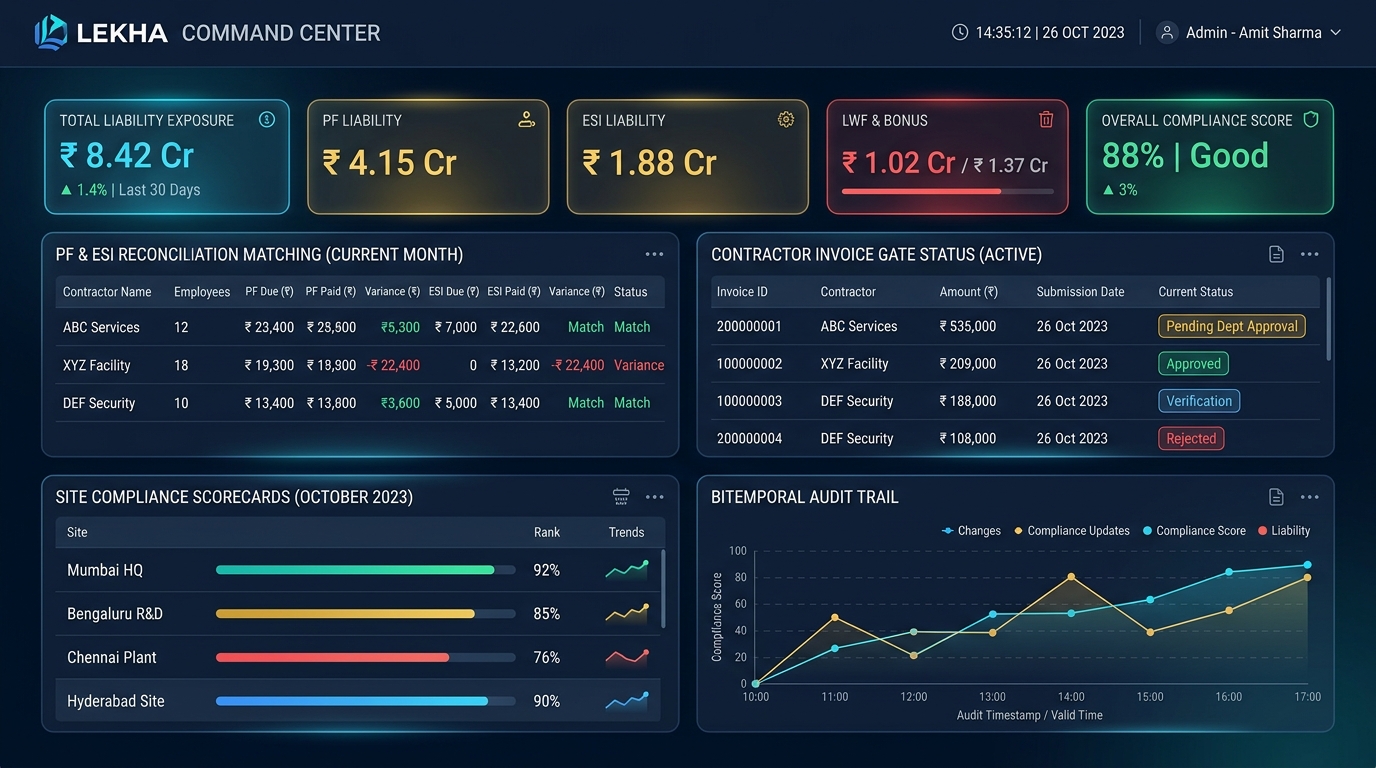
Parses statutory files and tests entitled, declared and remitted amounts for every worker-month, including late charges, damages and interest.
- Includes: Findings carry evidence, rupee value and ageing.
- Includes: Rule gaps return INDETERMINATE rather than a guess.
Hold payment until the gap closes
The gate holds or releases contractor invoices based on open exposure. Overrides need a named human, a reason code and a trail.
- Includes: Control-effectiveness reporting shows whether the gate held.
- Includes: Debit notes and recovery tracked to closure.
Worker identity and site access
Ghost and duplicate worker detection, onboarding eligibility checks, gate passes, a gate kiosk that works offline for 72 hours, and four-item exit clearance.
- Includes: Rejection reasons are shown in the worker's and officer's language.
- Includes: Exit settlement is matched before clearance.
Audit history and replay
A hash-chained audit log with anomaly detection, as-of replay to answer what was known on a given date, and hashed evidence packs.
- Includes: Bitemporal history of changes.
- Includes: Write-once evidence storage.
Inspection and notice support
Track inspections, EPFO 7A and ESIC C-18 notices and responses, and share a read-only, site-scoped, magic-link view with an inspector.
- Includes: Statutory-format registers in the required language.
- Includes: Evidence packs assembled from recorded data.
Rules as data, not code
Rules are authored, versioned and effective-dated with maker-checker approval and dry-run. A coverage view shows what is covered and what is a gap by jurisdiction.
- Includes: New notifications can be added without a code release.
- Includes: Two rulebooks can run side by side during transitions.
Trust and Governance
Controls built into the platform
The platform's controls are enforced below the application, not only in screens.
Isolation below the app
PostgreSQL row-level security is forced for tenants, and the application role cannot bypass it.
Separation of duties
Maker-checker on rules, dual approval on findings, and named overrides on the gate.
Safe document handling
Uploads are virus-scanned with fail-closed behaviour, and Aadhaar numbers are detected and redacted in working copies.
No portal credentials
LEKHA never asks for EPFO or ESIC portal credentials. Teams upload the files instead.
Who Uses It
One truth for every stakeholder
LEKHA serves the people who own the liability and the people who must prove compliance.
Plant and unit heads
Review contractor-default exposure for the sites they run.
CFO and finance
See open rupee risk by site and contractor, with recovery tracked to closure.
Compliance and IR managers
Run reconciliation, manage findings, registers and inspections every month.
Internal audit and legal
Replay what was known on any date and export evidence packs.
Frequently Asked Questions
LEKHA: common questions
What is LEKHA?
LEKHA is a contract labour compliance operating system for principal employers in India. It computes entitlements, reconciles them against contractor declarations and remittances, prices the gap in rupees and can hold contractor invoices until the gap closes.
Is LEKHA an HRMS or payroll system?
No. LEKHA is not an HRMS, a payroll engine or a document repository, and it does not file returns on the customer's behalf. It verifies and enforces what contractors owe.
Does LEKHA connect to the EPFO and ESIC portals?
No. LEKHA works from files such as ECR and ESIC uploads and never asks for portal credentials.
How does LEKHA handle changing labour rules?
Rules are data, not code. They are authored, versioned and effective-dated with a maker-checker workflow, and a coverage view shows which jurisdictions are covered and where gaps remain.
How does a customer get started?
Teams can start with a diagnostic on one to three months of muster rolls to see rupee exposure and a contractor scorecard before rolling out the full gate.
Explore More
Related Mativyx products
See how LEKHA sits alongside the rest of the Mativyx platform family on the products overview.
Shramiq
Contract workforce platform linking manufacturers, labour contractors and workers.
Coherence
Multi-plant industrial operations: compliance, permits, quality, contracts and OEE.
Flow
Tender, DPR, audit and cable-sizing workspace for EPC and industrial teams.
Talk To Mativyx
Check contractor compliance against your own data
Run LEKHA on your muster rolls and statutory files to see computed exposure in rupees.
Request LEKHA Demo